Recently I’ve been following a very interesting discussion on the LinkedIn Group PhD Careers Outside of Academia about the currency of PhDs and their value to their owners in terms of getting a job outside of academia. The discussion was provoked by an article entitled, The road to the structured PhD, which questions the value of PhD training for forging a career in business. The resulting comments from members of the LinkedIn group have been rich in individual experiences and personal stories and includes gems of wisdom and advice to peers. I have summarised some of the comments here (anonymously since the group is members only) to relate some of the shared insights from the discussion (you can see them all if you join the LinkedIn group):
“PhD recipients are full of potential. Yet many of them struggle to find jobs in industry. I don’t think it’s the fault of the job candidates or their training. I think it’s mainly because 1. There’s way too many of them, competing for too few jobs, and 2. Employers have little imagination when it comes to hiring. They so often play it short-term safe, refuse to do any training, and miss out on the longer-term prize.”
“I think it all goes back to the fact that PhDs are not trained for the reality of the job market they’re facing these days. PhD training is structured to serve the academic world. Very few PIs have the experience and/or feel comfortable to give advice and encourage for a career outside of the ivory tower. Therefore, few graduate students are prepared to enter the life science industry and what they’re prepared for is mainly a career in the research department. So what is left for a recent PhD? Many try to get into industry but have not learned how to “sell” themselves to those employers, so if they don’t hear back from job applications, the alternative is a Postdoc in academia, more technical training again tailored to stay in academia….. Our institution has taken a radical approach by designing a program that takes PhD scientists and engineers and teaches them general management skills focused solely on the life science industry, specific career path skills (like regulatory affairs, bioprocessing, medical devices design etc) and, crucial in our program, every student participates in a 2 semester industry sponsored team project. This exposes students not only to more strategic thinking but also provides situations that ask for team conflict management, time management and many more.”
“Consider what someone does to earn a PhD. They study their field until they are at the leading edge. Then they establish and conduct a research project that creates and documents something unique and significant. Along the way they have to demonstrate that they can form and lead a team, manage funding and budgets, and manage a project. They also have to pass many tests of themselves that stress their personality and dedication. These are all valuable traits to a company if the graduate can transition their learning to industrial reality.”
“During your PhD, you acquire new technical skills, but also soft skills that you can transfer in an industrial context. You manage your thesis project, you decide (with your thesis supervisor) of the guidelines, you manage people (trainee, technician), you interact with a lot of people and you present data in an efficient way.”
“I recall a conversation I had with my soon-to-be manager in my first job post PhD. He said “I am going to give you a chance, because someone also gave me a chance when I was a new PhD. You may be a brilliant addition to the organization, or you may fail miserably, but I will take that risk.” His words hold a lot of truth – some PhD folks are not well adapted to life outside of the tower. Others have little or no trouble. Whether you use your dissertation topic to further your career (I did not) or just leverage the vast amount of specialized training you received you must convince a potential employer that your skills translate – and to do so you must believe that yourself.”
So what can you do to increase the currency of your PhD to employers outside of academia?
1. Be aware of your skills and competences (such as project and financial management, teamworking and communication) beyond the subject of your research project, and understand their value to other career areas.
2. Identify gaps in your skills and experience relevant to your preferred career and try to address them by taking on additional work or courses during your PhD or postdoc.
3. Be able to communicate and market yourself to employers in an application form or CV.
Related blogs, pages and articles:
http://chronicle.com/article/From-Academe-to-Market/137965/
http://biosciencecareers.org/?p=36
http://biosciencecareers.org/?p=49

Be good to yourself …
…. “because you’re worth it”, says a major advertising company’s strap line. And you are!
Distracted by a personal crisis and possibly influenced by SAD, brought on by a lack of sunlight up here in the north of England, I recently found myself feeling rather uninspired and a bit flat. This resulted in me having lower motivational levels than usual and feeling generally lethargic, which is why my blog has been neglected of late. As things start to improve and the lighter evenings begin to kick in I can feel myself starting to come back to life again – hence the rediscovered motivation to write a new blog. I knew the ‘dip’ in enthusiasm would ebb away eventually – I just bided my time and accepted that you can’t work at 100% all the time. You need to listen to your body and respond accordingly, give yourself an occasional break, accept that you can’t be working 24/7, all year round.
“Luxury!”, I hear postdocs and postgrads cry. “We don’t have time for a break. We need to keep going; running experiments, generating results, analysing data, writing papers and so on. It’s all we can do to fit in the odd conference or departmental seminar!”
I’m generalising here of course, as I know not all researchers think this way. However, if you’re one of those who does, take a few minutes out of your schedule to read the following five suggestions, which hopefully demonstrate that even when you’re not doing research you are still being productive:
1. Read something other than scientific papers relevant to your research – it could be a novel, newspaper, blog, or research/review paper from another field. Reading widely broadens your horizons and promotes innovative ideas, even blue-sky thinking.
2. Treat yourself every now and again – eat your favourite meal, go for a walk, do yoga, watch a movie, go shopping – it’s amazing how ideas can come to you when you’re relaxing and enjoying yourself.
3. Get involved in extra-research activities, e.g. join a learned society, where you will receive a membership newsletter, discounted conference fees and access to travel grants (and a little independence!).
4. Attend career development events – all early career researchers have the right to professional development to help improve their prospects in a range of careers.
5. Prioritise your workload – use this model to guide you:
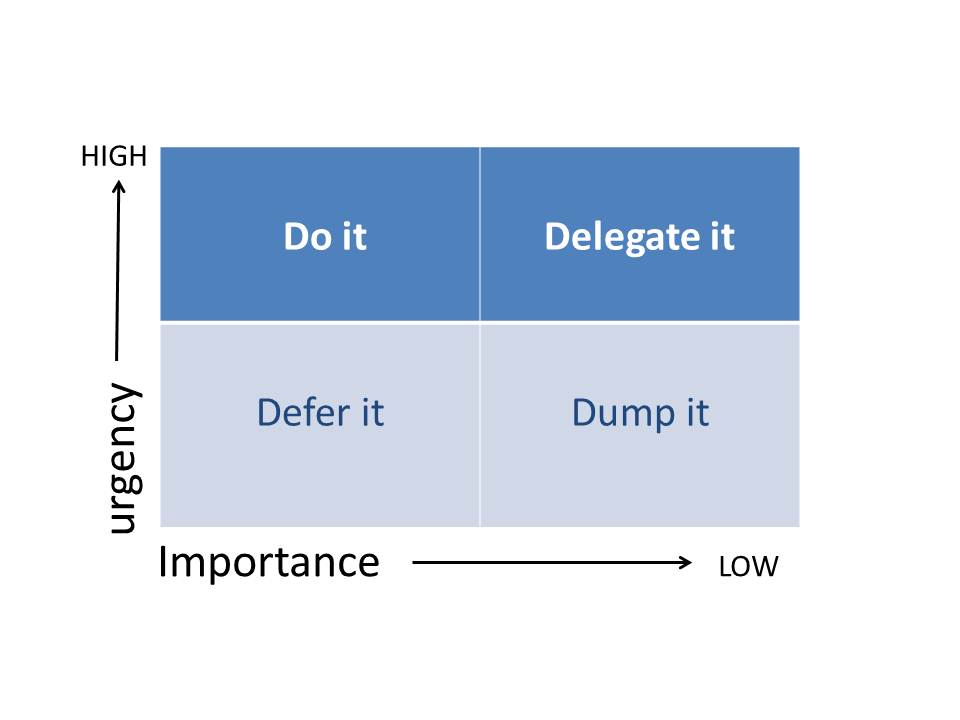
Of course, the obvious caveat to this blog is that if you’re reading it I’m probably preaching to the converted, and you’re already doing these things anyway! 🙂
Finding the ‘right’ career path
Reading over an interviewabout my career recently, which described the moment when I realised that the things I enjoyed about science were not the experiments themselves but rather all the other things I got to do as a scientist, it occurred to me, “If only I’d known then what I know now, how much easier my life would have been.” Specifically, if I’d known that I wasn’t a particularly technical person and that communication and helping people were where my strengths lay, I would have started my career off on the right footing. Instead, I careered around in the dark for quite a few years before finding my ‘calling’.
“Hindsight is a wonderful thing”, as the saying goes: it’s easy to review the past and make wise observations in the light of new information. My former self would probably jump at the chance of some insider information from my current self to help me on my way, but would this be a wise move? Would my life have been as rich and interesting if I had made no mistakes from which to learn? Mistakes can help us to increase our self-knowledge, build our capacity to deal with life’s difficulties and make us wiser about ourselves and the world around us.
So if you’re currently reflecting on your career and wondering whether some of your previous decisions were flawed, don’t be dismayed: You can’t do anything to change the past, but you can change your future. If you think you’ve taken your career down the wrong path ask yourself, where does it feel particularly comfortable or uncomfortable? PhD students and postdoctoral researchers may be unsure about their career prospects in academia, but there are many other options to consider. Those working in industry may be looking for a new challenge, perhaps a change of scenery, a different emphasis on their everyday work. Review what you do – your likes and dislikes – discover where your passions lie (including things you do outside of your research). Even if you feel that now is not the right time to be making a career transition, you can take action to enhance your talents and build on your strengths. It needn’t be something big and expensive, it could simply be to get a paper written, make contact with someone to help you with an alternative idea, investigate a course or conference. All the things you do, including the ‘mistakes’, will ultimately jigsaw together to form a pattern for your career; a career which is comfortable fitting and suits your abilities, interests and ambitions :).
Related content: Enhancing your employability ; Self awareness

“Wordle” your CV

If you’re wondering whether your CV or application form is getting across your key messages why not cut and paste it into EDWORDLE and see what your word cloud looks like. If the largest, most prominent words are those which you consider promote your best assets and/or match your current job specification then it’s achieving its aim. If not, you may want to reconsider the way in which you are presenting yourself.
I’m quite happy with the results of mine above. Have a go and see what yours looks like – it’s a fun and interesting way of looking at yourself 🙂
Career alternatives. What career alternatives?
What happens if you’re a researcher, working in a university or research institute, who’s thinking of moving into an ‘alternative’ career? How do you go about it? What else is on offer? How do you find out about this mysterious ‘alternative’ job market?
These were the questions posed during a postdoctoral career workshop I contributed to last week in London. Although many of the participants voted for a career in academia as their most favoured option, they acknowledged the need to consider a ‘Plan B’ or ‘C’ if things didn’t work out in terms of number and quality of publications – since this has become (albeit rather short-sightedly) the research metric of the 21st century for many institutions and funding bodies.
But what other careers are on offer? Well… teaching… But what else? As it happens, not many other ideas were forthcoming, let alone where to find out about them and then how to apply. My guess is that this lack of ‘alternative career’ knowledge acts as quite a barrier to many researchers as they become institutionalised and myopic in their career perspective. This is only to be expected when you exist in a rather homogeneous environment where the only promotional aspiration is to be a lecturer or principal investigator.
However, fear not, help is at hand. Life does exist beyond the ivory tower! Postdoctoral researchers have a wide range of opportunities they can consider other than academia, many of which are as exciting (if not more so) and offer equal rewards and benefits (if not more so). Obviously, it depends on factors such as your personal interests, skills, values and personal circumstances as to what will suit you but if you widen your horizons and look over the academic parapet there’s a really exciting world of work out there! My suggested plan of action is as follows:
1) Put your research skills into action and apply them to your job search. Examine the job sites beyond academia and stop using your discipline as the only keyword to scan the job market. See my extensive list of resources as a starting point – http://biosciencecareers.org/p/career-resources.html
2) If you’re collaborating with industry partners ask them about career opportunities in their company or elsewhere.
3) Network more extensively at conferences (talk to business and publishing exhibitors).
4) Use social media to enhance your profile (e.g. Researchgate, LinkedIn, Twitter).
5) Attend career events – see http://biosciencecareers.org/p/education-policy-careers-meetings.html
6) Try out alternative careers/enhance your employability through volunteering, workshadowing, internships, courses and workshops.
7) Examine case studies and career narratives of others who have left academia to pursue an alternative career. See Appendix 1 of ‘Career planning for research bioscientists’ which has 20 career stories and information about other resources available on the web.
8) If you have access to a careers consultant at your university or institute book an appointment to discuss your career ideas in a one-to-one careers interview.
7) Examine case studies and career narratives of others who have left academia to pursue an alternative career. See Appendix 1 of ‘Career planning for research bioscientists’ which has 20 career stories and information about other resources available on the web.
8) If you have access to a careers consultant at your university or institute book an appointment to discuss your career ideas in a one-to-one careers interview.
Related content: career alternatives; enhancing your employability
Quantity vs Quality
How many job applications should you make? Should you send out as many as possible to maximise your chances of success or should you send out just a few well-targeted quality applications? This was a question put to me recently when I ran a career workshop entitled “How to recession-proof your career”. For doctoral students and researchers coming towards the end of their PhD or contract it is a dilemma: should you flood the market with your CV and applications or should you be more discerning?
While there is no definitive answer to this question, there are three main factors to consider in answering it:
1) How much time do you have? Making applications is a time-consuming process which may distract you away from other equally important pursuits such as writing up your thesis or preparing papers for publication. If you don’t particularly enjoy the writing process (and many researchers don’t) you could easily spend a disproportionate amount of time on job applications when, in fact, the very activities which will enhance your application still need to be completed.
2) What is your career intention? Have you made a clear and informed decision about where you want to take your career (even if only in the short-term)?
If you know what you want to do next, e.g. apply for a postdoctoral position or fellowship, a research post in industry, a technical post, teaching etc., you can formulate an application and/or CV which reflects the experience and skills required by the employer. Even so, every application you make still needs to be re-tuned to satisfy the finer details of the post so that you are matching yourself as closely as possible to the requirements of the position. On top of this, a covering letter is also normally needed to accompany the application and, as with any précis or summary, it needs to be focussed and succinct to maximise impact, which can take some time to write.
If you are undecided about your next career move, you may be tempted to send out applications to a wide variety of advertised jobs in the hope that one of them will be successful. Generally speaking, I would recommend against this, not only because you will find it difficult to sell yourself to many and varied employers, but also because by making applications without having determined what it is you want and are suited to do, you are missing out a crucial step in your career planning – see a previous blog on self-awareness. In this case, your applications may come across as being superficial by the employer and you will be unlikely to secure an interview. Having said that, I don’t propose you only apply for one type of post, but if you want to spread your options, I would suggest you settle for one other career track (which may be made up of a number of similar associated jobs). For example, perhaps you are considering research in academia and/or research in industry as two career options. These are closely related but the jobs are advertised on different internet sites (see career resources) and will have subtle differences in their job specifications meaning you will need two types of CV – an industry and an academic one. Applications will take time to compose so that you ensure you are placing emphasis on the key experience and skills, qualities and achievements which will be of most interest to a research group leader in these two different sectors.
3) Do you need to make a compromise? There are a number of reasons why you may need to compromise your career: the recession is starting to bite hard with funding and research positions more difficult to find; your research may not have resulted in many high impact papers; you may be restricted in terms of your mobility and need to limit your job search to the local area. When you compromise your career you have to be more creative and open minded about what you are prepared to do. Technical posts or teaching may seem more attractive than they did previously, you may even think about non-scientific administrative posts being advertised in your institution. If this is the case, be very careful about how you approach each of your applications. Each post may differ considerably from another in terms of the type of job, work environment and candidate requirements. Job adverts will be attracting professionals who are already working in the sector so your application must be highly targeted, demonstrating the transferability of all your experience, so that you set yourself at a level which is comparable to your adversaries. If you find your applications are consistently unsuccessful, examine the gaps in your skills and see if there is something you can do to fill them to improve your chances in future (e.g. enrol on a course, do some voluntary work, network, etc).
Making applications can be likened to writing an essay or taking an exam. You need to read the question, underline the key words and then answer to your best ability within the confines of the time and space allowed. For job applications, the clues can all be found in the job and personal specifications. Read them, highlight the key requirements and then write your application accordingly. This will take time and energy so if you try to do too many, too disparately, you may be reducing the quality of your applications. Consider the application process as just one part of the whole career planning process in which other activities are just as important such as researching opportunities, networking, self-analysis and enhancing your employability. Make your applications, but never compromise quality over quantity.
Related content: Job applications
Do I stay or do I go?
One of the major decisions many postdocs struggle with at some point in their career is whether to continue to pursue their current career track and aim for a permanent academic position, or whether to cut their losses and get out before they are pushed out. Whilst it is relatively easy to secure a first or second postdoctoral position – since it is usually highly relevant to previous PhD research – moving from a junior to a more senior ranking post is harder, and becoming more so as funding cuts start to bite.
Unlike the academia of 20 – 30 years ago, the working culture is much tougher and more competitive nowadays what with journal impact factors, personal H-factors, pressures on funding and the rise of new global research competitors. Whilst the number of professorships and lectureships may not have diminished, there are far more PhD studentships and postdoctoral research positions available, and permanent departmental technician posts have all but disappeared in many universities. As a ‘second-best’ scenario, many postdocs would consider a permanent faculty research/technical post so that they can realise a more balanced and stable working life. However, although recent national policies have improved the rights of contract research staff in many countries, it is still the case that postdocs are funded on ‘soft’ external money, while institutional technical and research positions are funded internally by the institution itself (which may not have the budget or the will to create such posts). On a personal level, postdocs would need to be willing to change their research focus to adapt to the requirements of the department which, understandably, many are not prepared to do.
What do postdocs themselves think? There’s been an interesting recent discussion on one of the LinkedIn groups I subscribe to “PhDs outside Academia” asking the question “Why do you want to leave academia?” Here is a snapshot of some of the replies:
“Some leave academia because they realise that they actually don’t like research / teaching / work-life balance; some leave for the money and some leave due to pragmatic reasons. In my case, I love research and am good at it, I love teaching one on one, I love the interaction with others. However, my research track record while good, is not outstanding. To get a grant funded position requires “outstanding”. I might be able to work in someone else’s lab. But that opportunity hasn’t arisen – and a government job has. The job I am going to pays twice as much as academia and acknowledges my previous 25 years of clinical experience, which academia doesn’t. I hope to keep my research going in the spare time…”
“Among the many reasons I left Academia is the lack of a clear career path: I don’t want to move from temp job to temp job, aka postdoc, in the hope I’ll get a professorship in my 40s— it’s too much of a gamble and the risk is not hedged at all.”
“What really gets me is the mobility requirement… It is often the case that – if you fail to secure a grant to continue at the institution you are based at (which you often do considering the fierce competition) – you have to relocate to another town (or country!) to work on a project within your field of expertise. At some point you just don’t want to move any more…”
“To be successful in academia and get your own lab, you need to be in the top 1% of all the scientists out there. Unfortunately I am in the 99% group that try hard, publish some things but will never fly with the elite … I really enjoy supplying technical support to the students in the lab, experimental design, equipment management and general lab management. So I will be looking at the Industry side of things where I can do these kinds of roles, but these positions don’t come up too often in Australia. When you have a family it is more difficult to be flexible and travel to where the work is available too.
“It seems to be consensus that reaching that work/life balance in academia is increasingly difficult with all the pressure of performance and limited funding.”
“I recently took a job in industry because I was faced with the decision of moving to a foreign country without my spouse (for a 5 year staff position at a prestigious research institute). After 4 years as a post-doc, I had decided not to apply for more temporary jobs, especially after having received a fellowship where most other positions might find me overqualified/too expensive. The current 6+ year temp job situation is not what I realized the field was like when I started grad school and I needed more stability, which I think an industry job will offer.”
Many of these replies are from postdocs who cite mobility and work/life balance as the key reasons for choosing to leave academia. Many consider industry to be a favourable alternative because the relative security and stability are more suited to those who have settled down in their lives or who want a more structured supportive career. Searls (2009) sets out 10 rules for choosing between academia and industry and briefly mentions other alternative careers postdocs could consider (although there are many more – see a previous blog). He cites factors such as timing, career ambitions, personality and desires as influencing this decision and ends philosophically saying that career choice is not irrevocable.
If you are a postdoc who is currently going through this dilemma it is well worth seeking support to discuss your options and weigh up your circumstances so you can make informed decisions about your short- and long-term prospects. Many situations in life call for some kind of compromise and, during the course of your career, you will need to decide where and when compromises need to be made with regard to personal and work life balance.
Many of these replies are from postdocs who cite mobility and work/life balance as the key reasons for choosing to leave academia. Many consider industry to be a favourable alternative because the relative security and stability are more suited to those who have settled down in their lives or who want a more structured supportive career. Searls (2009) sets out 10 rules for choosing between academia and industry and briefly mentions other alternative careers postdocs could consider (although there are many more – see a previous blog). He cites factors such as timing, career ambitions, personality and desires as influencing this decision and ends philosophically saying that career choice is not irrevocable.
If you are a postdoc who is currently going through this dilemma it is well worth seeking support to discuss your options and weigh up your circumstances so you can make informed decisions about your short- and long-term prospects. Many situations in life call for some kind of compromise and, during the course of your career, you will need to decide where and when compromises need to be made with regard to personal and work life balance.

To say “I don’t have time” is to say “I don’t want to.” Lao Tzu
 Since a landmark birthday two weeks ago, I’ve been considering time and how strange an entity/ dimension it is. We all say it seems to speed up as we get older. When you’re 4 years old, one year is one quarter of your life. Multiply that up by 10 and one year becomes a much smaller proportion of your existence. Then, before you can say tempus fugit, you’ve reached another landmark birthday and you’re looking back on the past 10 years wondering where that time has gone. Time is a precious commodity – like money it can be spent but, unlike money, it cannot be saved. You can spend less of it and you can definitely waste it, but you can’t save it. I say this as someone who has probably wasted more time than I have spent wisely (although that does include lots of time spent having fun), so I know how easy it is to take it for granted. Sorry if this sounds like a mid-life crisis by the way – if you read on you’ll see there is a point to this blog 🙂
One of the biggest frustrations in my work is when researchers/ students sign up for a workshop I’m running and then don’t turn up citing the excuse that they are too busy and don’t have time to attend. Equally, I hear many researchers saying they don’t have time and are too stretched to do any extra-research activities such as attending conferences, getting involved in outreach events, going along to internal seminars or clubs, etc. Is this really the case I ask myself? Or is it simply bad time management. I’m guessing it’s a combination of the two: too much to do so lab work is prioritised over everything else. Publishable results and papers are important for a future career in research, but they are “not the only fruit”. If early-career researchers don’t make the effort to develop their careers through networking, communicating more widely and generally paying attention to their personal career development they may not be spending their time as wisely as they could be. Extra-curricular out-of-hours projects can be as important, sometimes even more so, than the core of the PhD or postdoc job requirements.
Today is the release date of my book “Career planning for research bioscientists” which, being an ancillary project to my paid job, took me three years to write. During that time, I substituted beach holidays for writing retreats, disappeared at weekends, and even gave up two Christmases. My motivation was tested to the limit as I struggled to take my leisure time a lot more seriously, rationing it between writing the book and time spent with friends and family, keeping fit and even basic needs such as eating and sleeping. I’m sure anyone who’s written up a PhD thesis can relate to some of this! Now that my book is being published and I can see the fruits of my labour, I’m glad I dedicated so much time to writing it. The sense of achievement is immense, as well as the feeling that it’s going to be a useful resource for bioscientists. In fact, I had an early book launch two weeks ago on my landmark birthday as I thought, having put in so much hard work, a fun celebration with my much-neglected friends and family would act as the perfect antidote (and, of course, the launch cake was a convenient diversion to the birthday cake with its furnace of candles – thanks to baking queen, Catherine Kitching, pictured far left below).

My closing point to this ‘timely’ blog is that once time has passed there’s no getting it back – I realised this a bit late when I had to ask my publisher to extend my deadline by a year, having not taken time seriously during 2009 and wasting much of it doing ‘other things’. Luckily they agreed. No such luxuries exist for the 3-year PhD or fixed-term research contract, so think about time and use it carefully. Consider what you want to achieve by the end of your contract in order to secure your position for the next career transition – and if you’ve signed up for a workshop make sure you attend – most universities offer training sessions on time management and self-motivation so this might be a good starting point!
Anyway, better dash, can’t spend any more time on my blog …. Got to get on with some real work!
Research Staff Associations
Saturday 14thJuly 2012 saw the launch of the International Consortium of Research Staff Associations (ICoRSA) – www.icorsa.org – at the European Open Science Forum (ESOF) Meeting. The purpose of ICoRSA is to bring together all the national and international research staff/postdoc associations to represent the interests and views of researchers.
I have listed below doctoral and research staff/postdoctoral associations which are active around the world, but local associations also exist in departments and universities, set up by active individuals who want to create a group specifically centred on the needs of researchers. If you are a PhD student or postdoctoral researcher why not check out your own institution to see if such an organisation exists, or else set one up yourself with a friends and colleagues. Many departments provide a small budget to help run seminars and invite outside speakers or cover other activities you choose to engage with such as career development and social activities.
|
Country
|
Association/Organisation
|
Web Address/email
|
|
USA
|
National Postdoctoral Association (NPA)
|
|
|
UK
|
UK Research Staff Association (UKRSA)
|
|
|
France
|
ANDes
|
|
|
France
|
CJC Jeunes Researchers
|
|
|
Ireland
|
IRSA
|
|
|
Norway
|
UIT Stipindat
|
|
|
Finland
|
|
|
|
The Netherlands
|
Postdoc Career Development Initiative (PCDI
|
|
|
Europe PGRs
|
Eurodoc
|
|
|
Canada
|
Canadian Association of Postdocs (CAP)
|
|
|
Brazil
|
SBPC
|
|
|
South Africa
|
National Research Foundation (NRF)
|
|
|
Australia
|
University of Western Australia Researchers’ Association
|
|
|
International
|
World Association of Young Scientists (WAYS)
|
For more information visit: http://www.vitae.ac.uk/researchers/305191/Guide-to-Research-Staff-Associations.html
Associated information: http://biosciencecareers.org/?p=66
Finding the Hook
These are just two of the headlines generated from research which was presented at the Society for Experimental Biology (SEB) Meeting 2012(#seb2012), Salzburg. This year’s SEB press intern, Catie Lichten, generated a number of press stories identified from abstracts submitted in advance of the meeting, some of which ended up on BBC Nature as well as a multitude of other international media.
In my previous blog, “If you don’t talk about it, you haven’t done it”, I wrote about the importance of communicating your research to the public and the variety of ways in which you can achieve this. The media represents a really powerful global outlet for communicating research through TV, radio, news websites, newspapers and magazines. If you want to improve your research impact in terms of its global reach, you need to know how to make it marketable to the press – you need to “find the hook”.
Most universities employ a press officer who can help you to write a press story, however many do not have a science background so you may still need to take a hand in helping to write it. Key rules in writing an effective press release are as follows:
Consider the 5Ws: Who, what, when, where, why (and how).
Who is your audience?: What level of knowledge should you assume? Don’t use acronyms.
Opening paragraph:Introduce the scientists and the problem they are trying to solve.
Body of the text:What did you do, how did you do it, what did you find, what is your interpretation of the results?
Do’s: Explain EVERYTHING – don’t expect your audience to read between the lines.
Don’ts: Don’t give too much background or talk about control experiments, don’t write in the passive tense.
Be straight-talking: Don’t say “Three dimensional discontinuous arboreal environment” when you mean “wood”.
Include interesting facts: Surprises, Eureka moments, hardest/funniest things.
A picture paints a thousand words: Interesting video clips, images and other visuals can sell an ordinary story.
Timing: The press is usually interested in a research story which is about to be published in a journal or presented at a conference. Many journals offer a press service to journal authors so check with them before contacting your own university press office.
Embargo: You can submit your press release at any time if you impose an ‘embargo’ which prevents anyone publishing the information ahead of a specified time (e.g. you can embargo your press release to coincide with the date of publication or a conference presentation) to ensure maximum impact.
For further information see: BBSRC Media Guide and
Standing up for Science: a guide to the media for early career researchers
________________________________________________
Standing up for Science: a guide to the media for early career researchers
________________________________________________
This blog is based on a talk by Dr Kathryn Knight (Journal of Experimental Biology), which she presented as part of the Advanced Communication Strategies session, at the Society for Experimental Biology Meeting 2012 (#seb2012), Salzburg.
SEB subscribes to Eurekalert (US based) which is a dedicated science news site for journalists. The European news site, Alphagalileo, offers a similar service. Members of SEB, delegates of its meetings and authors of its journals can take advantage of its press service by contacting the SEB Education office (s.blackford@lancaster.ac.uk).